Photography ideas don’t have to come from a plane ticket or a rare sunset over some place you’ve never been. Some of the sharpest, most satisfying images come from a Tuesday afternoon at home when you’re staring at your camera wondering what’s even left to shoot. This article gives you ten concrete, doable projects you can start in the next ten minutes, no travel required.
You’ll get specific gear, settings, and subjects — not vague inspiration talk. By the end, you’ll have a running list of photo project ideas you can return to whenever the “I have nothing to shoot” feeling creeps back in.
Whether you’re brand new to a camera or you’ve been shooting professionally for years, everyday photography inspiration is closer than you think. It’s usually sitting on your kitchen counter, dripping down your window, or riding the same bus route you take every week.
Why You Run Out of Photography Ideas (And Why That’s Normal)
Every photographer, regardless of skill level, hits a wall where nothing feels worth shooting. This isn’t a sign you’ve lost your eye. It’s a predictable part of any creative practice, and understanding why it happens makes it much easier to push through.
Creative Block Isn’t a Talent Problem
Running dry on photography ideas usually means you’re bored with your usual subjects, not that you’ve run out of ability. Your brain filters out familiar scenes because it has already categorized them as “seen before.” The fix isn’t more talent — it’s a deliberate shift in how you look at what’s already in front of you.
Think of it like a writer staring at a blank page. The words exist; the trigger to start is missing. A concrete prompt, like the ones below, gives your brain a specific task instead of an open-ended “go be creative,” which is exactly what breaks the freeze.
How Professionals Push Through Dry Spells
Even photojournalists with decades of experience, like Steve McCurry, have described long stretches between assignments where inspiration didn’t show up on schedule. Local wedding and portrait photographers face the same thing between bookings — the phone stops ringing and the creative itch doesn’t disappear, it just has nowhere obvious to go.
What separates working pros from hobbyists who quit is a system. They assign themselves small, low-stakes projects instead of waiting for motivation. That’s the entire premise behind the ten photography ideas in this guide.
1. Turn Your Own Home Into a Studio
You don’t need a rented studio or expensive lighting kit to practice portrait and product photography. Your living room, kitchen, and bedroom already have everything required if you know how to use the light you’ve got.
Window Light Portraits
A north-facing window around 9am gives you soft, even, indirect light with none of the harshness of direct sun. Sit your subject a few feet from the glass, angled slightly toward it, and you’ll get portrait lighting that rivals a $200 softbox setup. A $10 sheet of white foam board held on the shadow side bounces light back into the face and softens dark spots under the eyes.
If you’re shooting with a phone instead of a DSLR, check out our guide on phone portrait photography tips for framing and focus tricks that work with this exact window-light setup.
Shooting Everyday Objects Like Still Life
A coffee mug, a bowl of fruit, or a stack of books becomes an interesting subject once you control the light and depth of field. Use a 50mm f/1.8 lens (often called a “nifty fifty” and available new for around $125 for Canon or Nikon mounts) wide open to blur the background and isolate your subject. Move the object closer to the window and watch how the shadows change shape as the sun moves.
For a longer list of things to photograph when bored inside your own four walls, our article on creative photography with everyday objects breaks down more subject ideas room by room.
2. Find Photography Ideas in Reflections and Shadows
Weather and time of day that photographers usually avoid — flat rain, harsh noon sun — actually produce some of the most graphic, striking images once you know what to look for.
Shooting Puddle Reflections After Rain
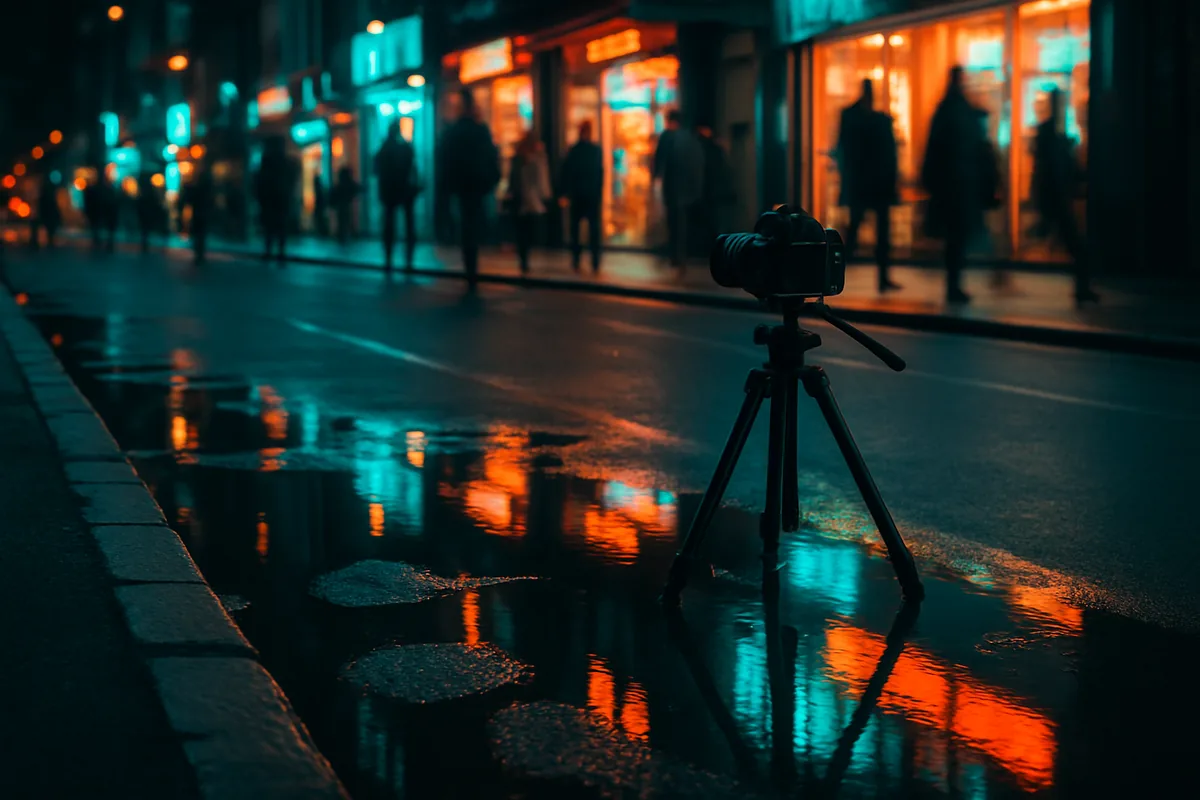
Right after a rain shower, puddles turn ordinary sidewalks into mirrors. Get low, sometimes with your camera or phone just inches off the ground, and frame the reflection so it fills most of the shot. Golden hour, roughly the hour after sunrise or before sunset, adds warm color to the reflected sky and makes even a parking lot puddle look worth a second glance.
Our full breakdown on reflection photography ideas and techniques covers puddle work along with glass, mirrors, and water reflections in more detail.
Using Midday Shadows for Graphic Shots
Photographers are taught to avoid the harsh light of noon, but that same overhead sun creates long, sharp-edged shadows perfect for graphic, high-contrast compositions. Shoot straight down at a person’s shadow stretching across pavement, or use a fence or railing to cast a repeating pattern across a wall. This is one of the easiest creative photo challenge ideas because it requires zero extra gear — just you, your camera, and the sun doing the work.
For ten more approaches to this technique, see our guide to shadow photography ideas.
3. Try a Macro Photography Challenge
Macro work forces you to slow down and notice detail that’s invisible at normal viewing distance, which makes it one of the best cures for creative burnout.
Photographing Textures Around the House
Macro photography subjects are everywhere once you start looking closely: the weave of a wool sweater, condensation on a cold glass, ice cubes melting on a countertop, or the surface of unroasted coffee beans. Set your aperture around f/8 to keep enough of the subject in focus while still getting that compressed, close-up look. Shoot in diffused window light rather than direct sun to avoid blown-out highlights on shiny textures.
Budget Macro Gear Options
You don’t need a $600 dedicated macro lens to start. A reversed lens adapter, which lets you mount a standard lens backward on your camera body, costs around $20-25 and turns any 50mm lens into a serviceable macro tool. Phone shooters can get a clip-on macro lens for $12-20 that attaches directly over the existing camera module.
| Gear Option | Approx. Cost | Best For |
|---|---|---|
| Reversed lens adapter | $20-25 | DSLR/mirrorless shooters with a 50mm lens |
| Clip-on phone macro lens | $12-20 | Smartphone photographers |
| Extension tubes | $40-60 | Shooters wanting sharper detail without a new lens |
| Dedicated macro lens | $350-600+ | Anyone making macro a regular part of their work |
4. Document a Single Subject Over Time
Long-term photo project ideas build discipline in a way one-off shoots can’t, because they force you to find new angles on something you already know well.
The One Object, 30 Days Project
Pick one object — a chair, a tree outside your window, a coffee cup — and photograph it every day for 30 days without repeating the composition. This sounds easy until day 12, when you’ve genuinely used every obvious angle and have to get creative with light, weather, and framing to keep going.
Tracking a Plant or Pet’s Changes
A houseplant growing new leaves or a puppy going through its awkward growth stages gives you built-in change over time, which makes the project feel less repetitive. Documentary and portrait photographer Chris Ord has built entire portfolios around this kind of repeated, single-subject series, proving that consistency of subject often produces more compelling work than constantly chasing something new.
5. Explore Street Photography Close to Home
You don’t need a foreign city to practice street photography. Your own neighborhood, seen with fresh eyes, has just as much going on.
Shooting a Familiar Neighborhood Like a Tourist
Walk your usual route but pretend you’ve never seen it before. A 35mm equivalent focal length is the classic street photography choice because it’s wide enough to include context but tight enough to isolate a subject. Look for color contrasts, interesting light, and small human moments — someone waiting at a crosswalk, a dog watching through a fence.
Candid Moments on Public Transit
Riding a local bus or subway line specifically to shoot gives you a moving stage of unposed, natural moments. Shoot from the hip, keep your camera settings preset before you raise it (or don’t raise it at all), and always be ready to lower the camera and move on if someone seems uncomfortable. Respecting people’s privacy matters more than getting the shot — a good street photographer knows when to hold back.
For more on doing this respectfully and effectively, check our guide on candid travel photography tips, which applies just as well two blocks from your apartment as it does abroad.
6. Use Props and Simple Tools for New Photography Ideas
Cheap tools can unlock entirely new photography ideas without requiring a new lens or camera body.
Prisms and Glass for Creative Distortion
A glass prism, sold for around $15-20 online, held close to your lens creates rainbow flares and distorted, dreamy foregrounds when angled toward a light source. Place it right at the edge of your frame and rotate it slowly while looking through the viewfinder to find the effect you like.
Flashlights for Light Painting at Night
A basic flashlight, the kind you already own for emergencies, becomes a drawing tool in a dark room. Set your camera to bulb mode, ISO 100, and around f/11, then keep the shutter open for 10-30 seconds while you move the flashlight to “paint” shapes or write words in the air. This is one of the more fun things to photograph when bored at night, and it costs nothing beyond batteries.
7. Recreate a Photo You Admire
Studying and rebuilding a photograph you love is one of the fastest ways to absorb technical and compositional skill.
Studying Composition From Photographers Like Vivian Maier
Vivian Maier’s street photography is full of tight, geometric framing and strong use of shadow and reflection — pick one image, study exactly where she placed the subject in the frame, and try to rebuild that same structure with your own scene. This isn’t about copying for copying’s sake; it’s a fast way to internalize composition rules that would otherwise take years to notice on your own.
Adding Your Own Twist to a Classic Shot
Once you’ve recreated the framing, change one variable — swap the subject, shift the color palette, or shoot at a different time of day — to make the image genuinely yours. This single-variable-change method is a reliable creative photo challenge you can repeat with a different photographer’s work every week.
Building a Habit So You Never Run Out of Photography Ideas Again
The photographers who never seem to run dry aren’t more talented — they’ve just built a system that catches inspiration before it disappears.
Keeping a Running Idea List on Your Phone
Open a notes app and start a list titled “photography ideas” today. Every time you see something interesting — a shadow, a color combo, an object — jot it down in five seconds, even if you can’t shoot it right then. Within a month you’ll have a backlog of dozens of photo project ideas waiting for a slow afternoon.
Setting a Weekly Shooting Challenge
Give yourself one narrow rule per week: shoot only reflections, shoot only red objects, shoot only from a low angle. Constraints like this remove the paralysis of unlimited choice and consistently produce more interesting work than “shoot whatever.” At the end of each month, review what you shot and look for patterns — a subject or style you keep returning to is usually worth developing into a bigger project.
If you’re shooting mainly on a phone, our 15 creative photography ideas to try at home guide pairs well with this weekly-challenge system and gives you a deeper bench of prompts to draw from.
Your Next Shoot Starts Today, Not Someday
You don’t need a new location, a new lens, or a new camera to make interesting images — you need a specific prompt and about twenty minutes. Pick one idea from this list, whatever sounds most doable right now, and shoot it before the day is over. Momentum, not motivation, is what actually keeps a photography practice alive.
For more background on the craft and its history, the Wikipedia entry on photography and the overview of macro photography are solid starting points if you want to go deeper on any of the techniques covered above.
Frequently Asked Questions
What do I photograph when I'm stuck at home with nothing new around?
Start with what you already own: a coffee mug near a window, the texture of a wool sweater up close, or shadows moving across your living room floor during the day. Limitation forces creativity, and some of the most interesting photography ideas come from ordinary objects shot in a new way.
How do professional photographers get photography ideas when they're not on a paid shoot?
Many pros run personal projects between jobs, like photographing the same street corner every week for a year or shooting only in black and white for a month. These self-assigned challenges keep their eye sharp and often turn into portfolio pieces or gallery work.
Do I need expensive gear to try these photography ideas?
No. A smartphone, a $15 glass prism, or a basic flashlight is enough for most of the ideas in this article. Creative constraints, not gear upgrades, are usually what push a photographer's work forward.
How often should I do a photography challenge to stay creative?
A weekly mini challenge, like shooting only reflections or only one color for seven days, is enough to build momentum without burning out. Monthly longer projects, such as documenting one subject for 30 days, work well alongside the weekly challenges.
Is street photography legal if I'm photographing strangers in public?
In the United States, photographing people in public spaces is generally legal since there's no reasonable expectation of privacy there. Still, it's good practice to avoid photographing people in vulnerable or embarrassing situations and to be respectful if someone asks you to stop.

Mark Finley is a professional photographer, educator, and the founder of FormLovers. With years of experience behind the lens, Mark has transitioned from a passionate hobbyist to an industry professional, capturing stunning visuals and mastering the business of photography.